Stanislaus County Public Records offer residents clear access to government documents, helping maintain transparency and accountability. These records include meeting minutes, property files, and official reports that allow citizens to understand local government actions. Access through the California Public Records Act (CPRA) ensures that information is available while protecting sensitive details. This transparency supports civic engagement and encourages trust between residents and local officials.
Government transparency in Stanislaus County means residents, journalists, and community groups can review decisions and track policies easily. Public document access under CPRA allows requests for copies or inspections, either in person or online. By providing structured procedures and digital portals, the county makes it simpler for citizens to stay informed about planning, budgets, and official actions. Open government practices strengthen oversight and keep the community connected to local decision-making.
What is Public Records in Stanislaus County
Public records in Stanislaus County Court are official documents maintained by government agencies that are available for review by citizens. These records cover a wide range of information, from administrative and financial reports to legal and personnel files.
In California, public records are governed by the California Public Records Act (CPRA), which ensures that local and state government information remains transparent and accessible. A public record is broadly defined as any document, report, or piece of data created, received, or maintained by a government office in connection with official duties. This includes both digital and paper formats.
Types of Stanislaus County Public Records
Residents and authorized individuals can request several types of public records in Stanislaus County. Some of the most common categories include:
- Administrative Records: Policies, meeting minutes, internal reports, and correspondence.
- Financial Records: Budget reports, expenditure logs, tax documents, and audit results.
- Legal Records: Court filings, ordinances, resolutions, and legal notices.
- Personnel Records: Employee directories, payroll summaries, and employment records (with privacy exceptions).
- Contracts and Agreements: Vendor contracts, procurement documents, and service agreements.
- Permits and Licenses: Building permits, business licenses, and environmental permits.
Who Can Request Stanislaus County Public Records
Any member of the public can submit a request for records. This includes residents, businesses, journalists, and organizations. Requests are generally open to anyone over 18, though certain sensitive information, such as medical records, juvenile records, and active law enforcement investigations, may have restricted access.
Requestors usually need to provide:
- A clear description of the record or information requested.
- Contact details for follow-up.
- Payment for any applicable copying or administrative fees.
How to Search Stanislaus County Public Records
Searching Stanislaus County public records can be done online or in person using official county resources. Users can perform a records lookup by name, date, case number, or document type through county portals, record indexes, or at county offices.
Official Search Portals
Here are the main government sites where public records can be searched:
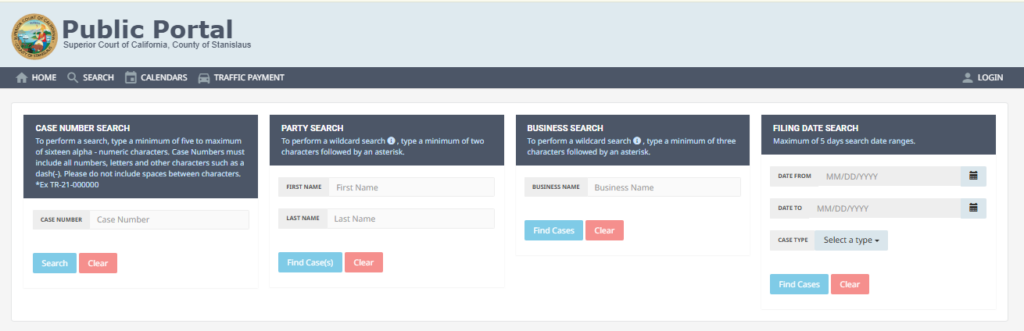
Superior Court Case Search (Official):
https://www.stanislaus.courts.ca.gov/online-services/search-case — search civil and criminal court cases by name or case number.
Stanislaus County Clerk‑Recorder (Official):
https://www.stancounty.com/clerkrecorder/ — for property deeds, official recordings, business filings, vital statistics, and more.
Steps for Online Records Lookup
- Choose the Type of Record You Need
- Court case info (civil, criminal, traffic) → use the Superior Court portal.
- Property deeds, recorded documents, or business filings → use the Clerk‑Recorder portal.
- Birth, death, or marriage certificates → also through Clerk‑Recorder.
- Open the Relevant Official Site
- Type the URL exactly into your browser OR click from this page. Government URLs ending in
.govor.comwith stancounty/stanislaus.courts are official.
- Type the URL exactly into your browser OR click from this page. Government URLs ending in
- Use the Search Form
On the case search page, you will see fields such as:- Full name
- Case number
- Document type or calendar choice
- Date range
Fill in as much known info as possible before searching.
- Apply Filters
If available, select a date range, case category, or record type to narrow results. Results list will update after submission. - Review Results
- Click result links to view details.
- Some documents (like full court filings) may not be available online and require a visit or a request form.
Example: Searching Court Records
- Go to:
https://www.stanislaus.courts.ca.gov/online-services/search-case - Pick “Public Case Access.”
- Enter either:
- First and last name OR
- Known case number.
- Check the list of found cases.
- Click any relevant link to view summary details.
Example: Searching Documents in Clerk‑Recorder
- Open:
https://www.stancounty.com/clerkrecorder/recorders/search-for-docs.shtm - On the search page, choose to search by:
- Grantor/Grantee (names on property deeds)
- Document number
- Date recorded
- Enter the name or document details.
- Submit and review the index results.
- In‑office terminals allow viewing scans and ordering copies.
Offline Search and Archived Records
If a record does not appear online:
- Visit the Clerk‑Recorder Office at 1021 I Street, Suite 101, Modesto, CA.
- Request copies or indexed views in person.
- Older records (pre‑1978) may be stored on microfilm and require staff assistance to access.
Useful Contact Info:
Clerk‑Recorder Office: (209) 525‑5250
Superior Court General Info (Main): (209) 530‑3100
CPRA Requests in Stanislaus County
A CPRA request in Stanislaus County lets people ask for public records held by county agencies under the California Public Records Act. Filing a public records request means submitting specific details so the county can locate and share records that are open to public review.
What a CPRA Request Includes
A CPRA request (California Public Records Act request) must clearly state what records someone wants. In Stanislaus County, this often means providing:
- Full name and contact info (email, phone, mailing address).
- Detailed description of the records (for example, reports, emails, case files, or meeting minutes).
- Date range or other specifics that narrow the search.
- Preferred delivery method (email, mail, or hard copy).
Steps for Filing a CPRA Request
- Write the Request:
Start with a clear statement that the request is made under the California Public Records Act. Then list the records needed. Keep language simple and direct so staff can match the request to available files. - Select a Submission Method:
Stanislaus County accepts requests by several paths:- Email: Send the request to the county records office email. Use a subject line such as “CPRA Request Stanislaus County.”
- Mail: Print the request and mail it to:
Stanislaus County Clerk‑Recorder
1021 I Street, Suite 101
Modesto, CA 95354 - Online Portal: If a web form exists on the county website (https://www.stancounty.com/), fill it out with the required fields.
Some departments also accept requests in person at the clerk’s office.
- Wait for Acknowledgment:
After sending, the county typically sends a receipt or confirmation that the request has been received. This usually happens within a few business days.
Fees and Payments
Some public records may have copying or processing costs. Common fees include:
- Paper copy charges (per page).
- Media costs (if records are delivered on CD or USB).
- Staff time for extensive searches.
Timeframe and Responses
Under California law, county staff often respond within 10 days with either the records or a status update. If more time is needed, the county should explain why and provide a date when records will be ready.
Checklist for CPRA Requests
Use this as a quick list before submitting:
- ☐ Full name and contact details
- ☐ Clear description of records
- ☐ Specific dates or case numbers if available
- ☐ Preferred delivery method
- ☐ Chosen submission channel (email, mail, online form)
- ☐ Budget for possible fees
Legal Framework and Transparency Laws
Stanislaus County public records are governed by state and local laws that ensure transparency while protecting sensitive information. The California Public Records Act (CPRA) sets the legal foundation, requiring government offices to provide access to public records upon request, subject to specific exemptions.
CPRA and County Obligations
Under the CPRA, any person may submit a public records request to a government office, including county departments, the clerk‑recorder, and the superior court. Stanislaus County offices are obligated to respond promptly, either by providing the requested records, granting partial access, or explaining why certain information is withheld. Responses generally occur within 10 days, though extensions are allowed for complex or voluminous requests.
The CPRA encourages accountability by mandating that records remain organized, searchable, and retrievable. Each department follows record retention policies to maintain files in accordance with state law, ensuring that official documents, meeting minutes, court filings, and property records are preserved for the legally required periods.
Disclosure Rules in Stanislaus County
Disclosure rules guide which records can be released and which may be withheld. Common legal exemptions include:
- Personal privacy protections, such as social security numbers or medical records.
- Ongoing investigations or law enforcement records where disclosure may compromise a case.
- Confidential business information submitted to the county under agreements.
Legal References
Stanislaus County follows both state statutes and local policies, including:
- California Government Code §§ 6250–6276.48 (the CPRA itself).
- County record retention schedules, which specify how long documents must be kept.
- Official county procedures for handling public records requests, including formats, submission methods, and fee structures.
Timeline and Response Expectations
Submitting CPRA requests in Stanislaus County triggers a defined process under California law, ensuring that public records are handled efficiently and consistently. Understanding public records response time helps requesters plan for delivery and follow up appropriately.
Standard Response Timelines
Under the California Public Records Act (CPRA), Stanislaus County agencies typically respond within 10 calendar days after receiving a request. This initial response may include access to the court calendar, case files, or other relevant records.
- Confirmation that the request was received.
- An estimate of when the records will be available.
- Notification of any clarifications needed to process the request.
For straightforward requests with readily available documents, the county often provides records within this period. Requests involving large volumes of files, complex searches, or archived material may require an extension. In such cases, the county must provide written notice explaining the reason for delay and an estimated completion date.
Delays and What to Expect
Some common reasons for delays include:
- Records stored in off-site archives.
- Requests requiring review for legal exemptions or redactions.
- High volumes of simultaneous public requests across departments.
Follow-up Procedures
If the response takes longer than expected, requesters can:
- Contact the County Records Office – Provide your request number, submission date, and record details.
- Ask for status updates – Staff can clarify whether additional information or payment is needed.
- File an appeal – If the county denies access to records, the requester can challenge the decision by citing the CPRA and requesting a written explanation of exemptions applied.
Exemptions and Restricted Records
Not all government records in Stanislaus County are available for public inspection. Certain record exemptions protect privacy, security, and sensitive operations while balancing transparency for citizens.
Types of Exempt Records
Some categories of records are restricted under state and local law:
- Personnel and employment files – Includes performance evaluations, disciplinary actions, and personal employee information.
- Law enforcement and security records – Ongoing investigation reports, confidential police logs, witness statements, and internal security protocols.
- Medical and health information – Records protected under HIPAA or other privacy statutes.
- Confidential business information – Proprietary documents submitted to county departments for permits, contracts, or financial matters.
How Exemptions Are Applied
When a CPRA request is submitted, Stanislaus County staff reviews the records and identifies any legal restrictions. Exempt sections may be:
- Redacted – Sensitive portions of a document are blacked out while the remainder is released.
- Withheld entirely – When disclosure would violate the law, the record is not shared, and the county provides a written explanation citing the legal basis for the exemption.
Alternative Ways to Access Restricted Information
Even if full records are exempt, there are ways to obtain useful information:
- Aggregated data or summaries – Many departments provide statistical reports, annual summaries, or sanitized versions of sensitive records.
- Court access – Some law enforcement or legal records may be available through court filings rather than the general public records system.
- Formal requests or subpoenas – Attorneys, researchers, or parties with legal standing may request restricted records through official legal channels.
Requesting Records Online vs. In-Person
Accessing Stanislaus County public records can be done either online or in person, depending on the type of record and user preference. Both methods provide reliable ways to obtain information, but they differ in speed, convenience, and available resources.
Online Records Request
Online submission through digital portals allows users to request records quickly without visiting county offices. The Stanislaus County Clerk‑Recorder and Superior Court websites provide searchable forms for court cases, property deeds, and other official documents. Users simply enter relevant details such as full name, case number, or document type, submit the request, and receive results via email or downloadable files.
Benefits of online requests:
- Faster response for commonly requested records.
- 24/7 access to submit forms and check request status.
- Reduced need for travel or physical paperwork.
Official Portal: Stanislaus County Clerk‑Recorder Public Records Portal
In-Person Requests
For records not available digitally or older archived documents, visiting county offices remains an effective option. Requesters can meet with staff at the Clerk‑Recorder’s office or Superior Court to review documents, submit forms, and request certified copies.
Advantages of in-person requests:
- Immediate assistance from staff to clarify record details.
- Access to physical archives and microfilm records.
- Ability to obtain certified copies on the spot.
Location and Contact Information
Individuals seeking Stanislaus County public records can contact specific county offices that handle requests for government documents. The main offices include the Clerk‑Recorder’s Office and department-specific records divisions.
County Offices
- Clerk‑Recorder’s Office – Handles vital records, property documents, business filings, and other official records.
- Superior Court Records Department – Maintains court case files, civil and criminal records, and archived court documents.
Contact Information
Clerk‑Recorder’s Office
- Address: 1021 I Street, Suite 101, Modesto, CA 95354
- Phone: (209) 525‑5250
- Email: clerkrecorder@stancounty.com
- Hours: Monday–Friday, 8:00 AM – 5:00 PM
Superior Court Records Department
- Address: 800 11th Street, Modesto, CA 95354
- Phone: (209) 530‑3100
- Hours: Monday–Friday, 8:30 AM – 4:30 PM
Directions for In-Person Submissions
Visitors should go to the main entrance of the Clerk‑Recorder or Superior Court offices. At the records counter, staff can assist with filling out request forms, locating archived files, and obtaining certified copies. For those submitting requests by mail, include full contact information, a detailed description of the records requested, and any applicable fees. Mailing ensures that requests are logged and processed even if the requester cannot visit in person.
Frequently Asked Questions
This section addresses common inquiries regarding Stanislaus County public records FAQs and CPRA requests, helping residents, researchers, and legal professionals navigate record access efficiently.
Are all public records available to the public?
Not all records are open for public inspection. While the California Public Records Act (CPRA) encourages transparency, certain documents are exempt to protect privacy, security, or confidential information. Examples include personnel files, ongoing law enforcement investigations, medical records, and sensitive business information. Exemptions are applied carefully, and in many cases, redacted versions are provided so that general information remains accessible.
How long does it take to get a response?
The standard response time for CPRA requests in Stanislaus County is typically 10 calendar days. During this period, the county acknowledges the request and may provide an initial status update. Requests involving large volumes of records, archived documents, or complex searches may require an extension. In such cases, the county provides written notice of the delay along with an estimated date for completion.
Can anyone request certified copies?
Yes, certified copies of certain records, such as vital records, property documents, or court filings, can be requested by the public. Requesters may need to provide identification and pay applicable copying or processing fees. Certified copies are considered official and may be used for legal, personal, or business purposes.
Are older records digitized?
Many records have been digitized, particularly recent court cases, property filings, and vital records. However, some older documents may only exist in physical form or on microfilm. For historical records, requesters may need to visit the Clerk‑Recorder’s office or the relevant county department to access archives. Digitization efforts continue, but availability varies by record type and age.
What if a record cannot be found or is denied?
If a requested record cannot be located, county staff will notify the requester and may suggest alternative sources or formats. If access is denied due to legal exemptions, the county provides a written explanation citing the applicable law. Requesters may appeal denials or submit a clarified request to improve the chances of obtaining the desired information. Being specific about dates, document types, and department names often helps in retrieving accurate results.